The Divorce Ended The Marriage. So Why Do You Still Feel Trapped In It?
What if everything you've been doing to heal has actually been training your brain to stay addicted to him?
For high-achieving women who've tried therapy, journaling, and giving it time — and still can't stop.

The divorce ended the marriage.
But it didn't end the emotional state your brain memorized while you were in it.
You don't have an ex problem.
You have an emotional addiction problem.
Not because something is wrong with you.
Not because you're weak.
Not because you haven't tried hard enough.
But because the addiction didn't start with the divorce.
It started inside the marriage.
Every argument.
Every betrayal.
Every moment you felt unseen.
Every time you braced for the next disappointment.
Every night you replayed what happened or tried to make sense of why you still felt so alone.
Your brain was memorizing that emotional state the entire time.
And now it keeps you in a loop — pulling you back to the thought of him to produce those emotions again.
That's why you keep thinking about him.
If you weren't addicted to those emotions, you would stop thinking about him.
But every time you go back into the story — every replay, every spiral, every attempt to make sense of it — you're not healing.
You're rehearsing.
Wiring the addiction deeper.
Making yourself more dependent on the very person you're trying to get free from.
That's why you can know he isn't right for you… and still feel pulled back in.
And You Can Feel What It’s Doing To You

He's the first thought in the morning.
The replay starts before your feet even hit the floor.
A song, a post, a memory — and you're right back in it.
And it's not just that you're thinking about him.
It's what it's doing to you.
More guarded.
More reactive.
Less present.
Less like yourself.
Performing confidence you don't actually feel.
Sitting in the car before walking inside because you need a minute to put the mask back on.
Nobody sees it.
Because you're still showing up.
Still handling everything.
But performing isn't the same as being yourself.
So you ask yourself...
"Why can't I stop?"
You're not addicted to him as a person.
You’re addicted to the emotions your brain has learned to create every time you think about him… replay the conversation… relive the betrayal… check his socials… or go back into the story one more time.
Let's Catch Your Brain In The Act

Think of him for one second.
Now notice what your mind does next.
"Why did this happen?"
"What was wrong with me?"
"Why wasn't I enough?"
"Why is this so unfair?"
Those questions aren't helping you understand.
They're rehearsing an emotional state.
And every time they run, your brain produces the same emotions.
You're not just thinking about him.
You're teaching your brain to crave the very emotions you're trying to get free from.
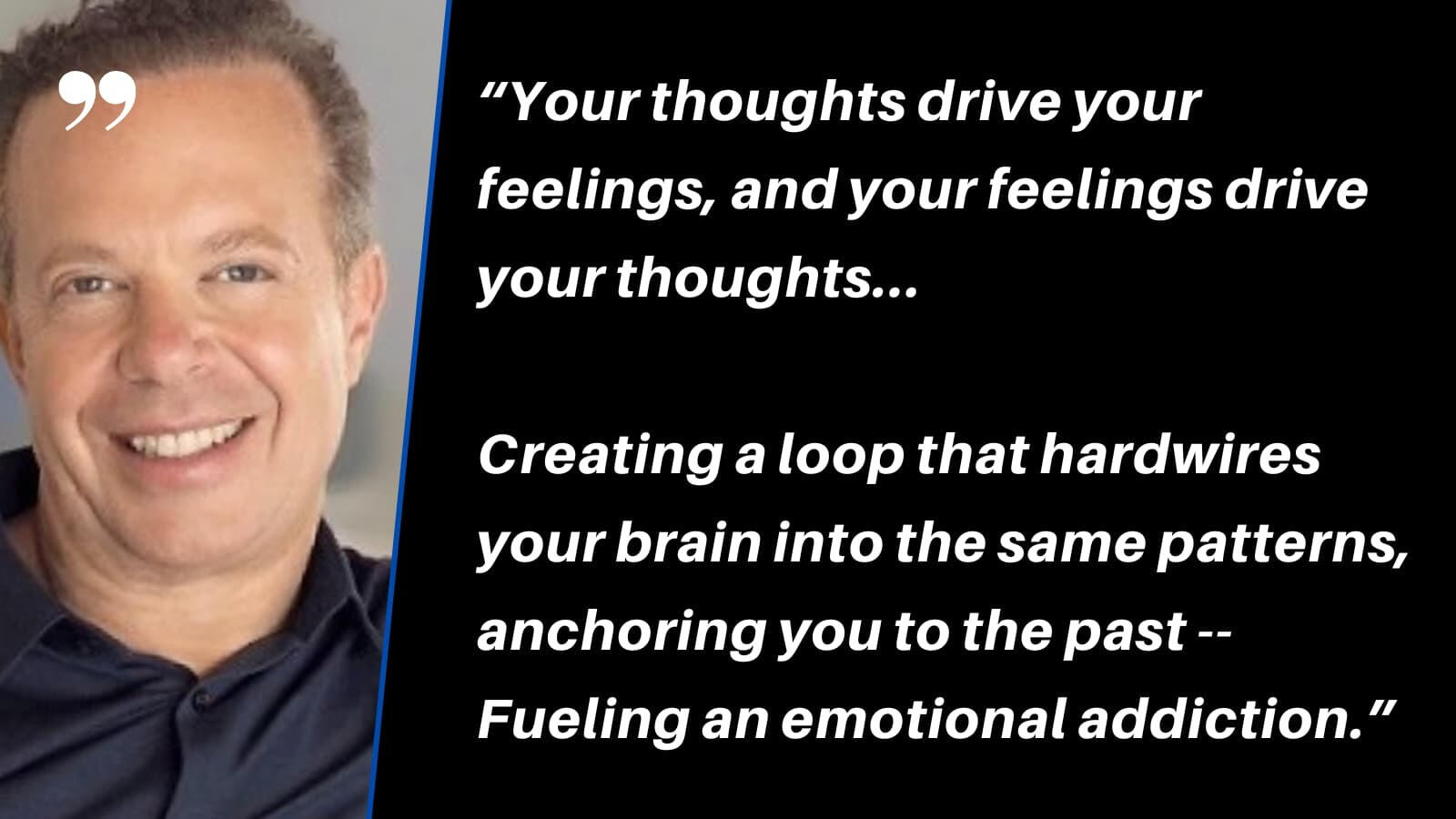
As Dr. Joe Dispenza, a Renowned Neuroscientist, Reveals:
Your Brain Memorized Him

When the rejection, the betrayal, the loss happened, your brain took a snapshot.
It froze the event, locked in the emotion, and attached the feeling to him.
So now, every time you think of him, your brain knows exactly what emotions to produce.
Your brain cannot tell the difference between the event happening and the memory of the event happening.
You haven't been remembering it.
You've been rehearsing it... reliving it emotionally.
Hundreds... thousands of times.
And every time you relive it, you wire the addiction deeper.
The more you replay, the deeper the wiring.
The deeper the wiring, the more automatic it becomes.
Until your brain starts depending on those emotions.
Craving them.
Looking for the next reason to feel them again.
And The Addiction Is Making Every Decision For You
That's why one thought, one song, one post, or one quiet moment can pull you right back in.
That's why you can't stop.
Your brain needs the story.
It needs something to point to.
It needs him — not because he matters, but because he's the quickest way to produce the emotions it craves.
That's why you can say, "I know I should be over this" and still not be over it.
That's why you keep settling for breadcrumbs when you know you're worth so much more...
because your brain will justify every reason to reach out, to respond, to let him back in, just to get that emotional hit.
It Was Never About Him

Knowing doesn't break addiction.
Your brain doesn't care what you know.
It cares what it craves.
We could put him in a rocket, send him to another galaxy, erase him from the planet.
And you would still wake up tomorrow with the same weight in your chest.
Because the emotions aren't coming from him.
They're coming from your brain.
And your brain has learned to use him as the excuse to keep producing the emotions it's addicted to.
But It Goes Deeper Than The Emotions

Your brain isn't just addicted to the emotions.
It's addicted to the meaning those emotions keep proving.
Because the divorce didn't just hurt.
Your brain decided what the hurt meant about you.
"I wasn't enough."
"I'm too much."
"I'm the one who gets left."
"I'm the one nobody really sees."
One of those just hit harder than the others.
That's the story your brain has been rehearsing every time you think about him.
Every replay, every spiral, every late night going back into it — your brain isn't just producing emotions.
It's collecting proof that the story is true.
He's not what's keeping you stuck.
The story about you is.
He's just what your brain uses to keep the story running.
And as long as your brain keeps using him to prove the story is true, the emotions keep firing, and the addiction keeps you exactly where you are.
Everything You Tried To Heal Has Been Feeding The Addiction

Every single thing you've been doing to get past this — the therapy, the journaling, the talking it through, the giving it time — hasn't just failed to break the addiction.
It's been feeding it.
Making you more dependent on the very things that were supposed to free you.
Every attempt to heal took you back into the story.
And the story is what produces the emotions your brain is addicted to.
So the more you tried to heal, the more you needed to heal.
That's the trap.
And Every Attempt Fed It

Therapy took you back into the story. Your brain produced the same emotions. You left lighter. By the end of the week, the weight was back. Because the story is the drug. And therapy kept taking you back into it.
Talking to friends let you retell it. Every retelling fired the same emotions. You thought you were getting it off your chest. Your brain was getting exactly what it's addicted to.
Journaling put you back in the feelings. You thought you were processing. You were practicing the emotions your brain craves.
Giving it time gave the addiction more reps. That's why six months quietly becomes a year. And a year becomes two.
Checking his page was your brain looking for its next hit. Not curiosity. Not love. Addiction.
The help became the trap.
You weren't failing to heal.
You were feeding the addiction that was keeping you stuck.
And The Longer It Runs, The More You Become The Story

Time doesn't just pass.
It gives the story more time to become you.
More guarded.
More resentful.
More closed off.
More bitter.
More angry at things that never used to bother you.
Until one day you look in the mirror and realize — the divorce didn't create this version of you.
The addiction did.
This Is Why You Can't Break Free

A thought repeated long enough becomes a mood.
A mood becomes a temperament.
A temperament becomes your personality.
Nerve cells that fire together wire together.
Yours have been firing together every single day since the rejection, the betrayal, the loss.
That's not heartbreak.
That's neural wiring.
The emotions aren't just feelings anymore — they're who your brain expects you to be.
You're addicted to an emotional state you'd do anything to escape.
And you didn't know it.
Because the addiction doesn't feel like an addiction.
That's why you keep snapping back.
Good days don't last.
Good weeks collapse.
Every time you rise above the old emotional state, your brain panics and pulls you back down.
"Check his page."
"Replay what happened."
"Something bad is about to happen."
"You're not actually over it."
Those aren't your thoughts.
Those are withdrawal symptoms.
And because they sound exactly like your own voice, you believe them.
And you go back into the story.
And the addiction gets another dose.
And the thermostat wins again.
Where This Is Going If Nothing Changes

Six months becomes a year.
A year becomes two.
And somewhere around year three, you stop noticing it's still happening.
The heaviness becomes your baseline.
The guardedness becomes your personality.
The bracing becomes how you show up in every relationship — not just romantic ones.
And your brain doesn't just carry it passively.
It actively looks for proof that the story is still true.
Someone does something completely neutral — and your brain assigns meaning to it.
A look.
A tone.
A comment that wasn't meant the way you took it.
It scans for micro-behaviors that match what your ex did.
And when it finds anything even close, it says: "See? This is what people do. This is how it always goes."
Then you meet someone new. Someone good.
Someone who's actually kind and consistent.
And it doesn't feel safe.
It feels wrong.
Because your brain has been wired to expect pain for so long that kindness feels like a setup.
Consistency feels like the calm before something breaks.
And when it can't find real evidence that something is wrong, it manufactures it.
A text he didn't respond to fast enough.
A compliment that felt off.
A moment of silence that must mean something.
And the closer they get, the more you pull away.
Not because of them.
Because the addiction needs the familiar emotions.
And a good relationship doesn't produce them.
Different person.
Same emotional experience.
Not because they're the same.
Because you're seeing them through the same lens.
That's where this is going if nothing changes.
Not dramatic collapse.
Quiet erosion.
Until one day you realize... this isn't temporary anymore.
It just feels like your personality.
What My Neuropsychologist Told Me That Changed Everything
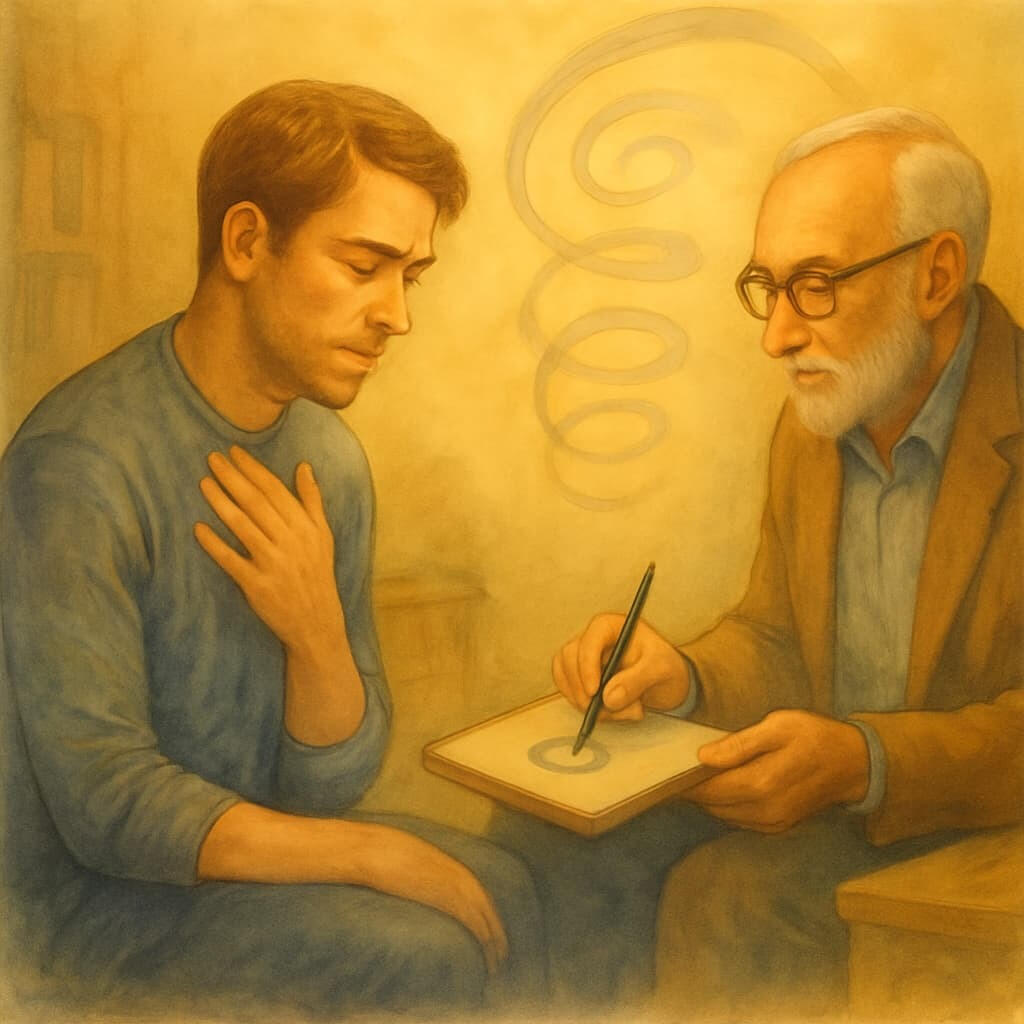
I spent almost three years stuck in this exact cycle.
By year two, I was someone I didn't recognize.
Guarded in ways I couldn't even see.
And one day my neuropsychologist Jerry said something I'll never forget.
"James, how can you escape from a prison you don't even realize you're in?
Every time you tell your story — to yourself, to your friends, to me in these sessions — you're not processing what happened.
You're feeding an addiction.
Those conversations — the ones you have in your car, in the shower, lying awake at night — they're not helping you heal.
They're training your brain to stay hurt.
Every retelling reinforces it.
And your brain will do anything to keep it running.
Think. Feel. Think. Feel. Think. Feel.
Until eventually you don't even need the thoughts anymore.
You're just left with the emotions — memorized as part of who you believe yourself to be.
That's why you have to keep coming back to me.
That's why you keep checking her page even though you know it's over.
That's why you keep replaying the conversation.
That's why you can't move on.
Not because you haven't tried.
Because every time you go back into the story, you wire the addiction deeper."
I realized, I wasn't trapped by what she did anymore.
I was trapped by an emotional addiction I didn't know I had — one I'd been wiring deeper every single day without realizing it.
And the moment I could see that, everything made sense.
It was never about her.
It was never about the therapy or the journaling or the time.
It was about the addiction I didn't know was running.
But seeing it wasn't enough to break it.
I needed a way to actually interrupt it.
That's what led me to develop The Rewiring Method.
How Do You Break The Addiction?

Here's what most people don't realize.
The only reason these emotions keep running is because they still feel relevant to the story your brain is telling you about who you are.
And the only reason he still feels relevant is because the emotions need him to be.
So you don't break this by forcing yourself to stop thinking about him.
You don't break it by trying harder.
You don't break it with willpower.
You break it by interrupting the story your brain has been using to keep the emotions alive.
Because when the story stops feeling true, the emotions start losing their fuel.
When the emotions lose their fuel, the wiring starts to weaken.
And when the wiring weakens, something shifts.
But There’s Something Deeper Keeping The Addiction Alive

Something most women never get to see.
There’s a layer underneath the emotional addiction that’s been fueling the story the entire time...
keeping every replay running, feeding every emotion, and pulling you back every time you think you’re finally making progress.
And you can’t see it from inside the pattern.
Not because you’re not smart enough.
Because you’re seeing through it.
The simplest way to explain it is this.
Have you ever seen those videos of someone who's been colorblind their entire life — and someone hands them a special pair of glasses?
They've been looking at the world their entire life.
They thought they were seeing the whole picture.
Trees, sky, their kid's face — they could see all of it.
But they were missing something massive.
And they had no idea.
Because the world they saw looked complete to them.
It's the only world they'd ever known.
Then they put on the glasses — and everything floods in.
Color everywhere.
And they break down.
Not because it hurts.
Because they suddenly realize:
I had no idea what I wasn't seeing.
I thought that was the whole picture.
It wasn't.
That's what's been happening with you.
The Emotional Blind Spot
You've Been Looking Through A Lens You Didn't Know You Were Wearing

This didn't start with the divorce.
The divorce just exposed it.
Your brain was assigning meaning long before that — every argument, every betrayal, every moment you felt unseen.
The divorce was just when it became undeniable.
And every time you replayed it — every time the emotions fired, every time that feeling came back — your brain rehearsed that meaning.
Thousands of times.
Until gradually, it stopped feeling like a meaning.
It just became the way you see.
How you see him.
How you see yourself.
How you imagine your future.
How you show up with your kids.
How you interpret what people say and do.
All of it — slowly colored by one perspective you didn't even know you were wearing.
And you can't see it.
Because it happened so gradually that it doesn't feel like a perspective anymore.
It just feels like reality.
It feels like who you are.
And here's what makes it so dangerous — you're not just seeing through it.
You're making every decision FROM it.
Who you trust.
What you tolerate.
What you believe you deserve.
All of it filtered through a perspective you never consciously chose.
It's not the pain.
It's not him.
It's not what happened.
It's that you've been seeing everything through one lens for so long that you forgot you're wearing it.
That's The Emotional Blind Spot
You don't see it. You see through it.
And That's Why Nothing You've Tried Has Changed It
You can't see beyond it on your own.
Because you've identified with the story so deeply that it doesn't feel like a story anymore.
It feels like who you are.
And when your brain is only showing you one version of reality — just like someone who's never seen color — you don't know there's anything else to see.
That's why therapy hasn't changed it.
Every session took you back into the same story from the same perspective — reinforcing the same identity. Nobody ever handed you a different pair of glasses.
That's why understanding hasn't freed you.
You understood your pain better and better — but understanding the story doesn't change the story.
You need a completely different way to see it.
The rehearsals fueled the addiction and built the pattern.
The pattern became the lens.
And the lens became the thing you can't see because you're seeing everything through it.
This Is What The Vision Call Is For

Imagine what happens the moment someone hands you those glasses.
You see your story differently.
You see him differently.
You see yourself differently.
You see everything you've been through from a completely new perspective.
And when you change the way you look at things — the things you look at change.
The meaning you've been giving your story stops feeling relevant to who you are.
It just falls away.
Your emotions shift — not because you processed them, but because you're seeing everything differently now.
How you feel about yourself shifts — because the old story doesn't look the same from this new perspective.
And the moment you see it — the moment your story stops feeling like the truth about who you are — the addiction has nothing left to run on.
You don't have to process the pain.
You don't have to "let go."
You just need to see it differently.
And the moment you do — like seeing color for the first time — you don't go back.
On your Vision Call, I show you the exact lens your brain has been looking through — the meaning it attached, the perspective it created, and why nothing you've tried has been able to reach it.
Most women walk away feeling lighter than they have in months — because for the first time, they can finally see what's been keeping the addiction alive.
And once you can see it, you can start breaking it.
And When The Addiction Breaks, This Is What Changes
He stops feeling relevant.
Not because you forced yourself to forget.
Because the emotions that kept making him relevant aren't running the same way anymore.
There's nothing left for your brain to keep using him to prove.
Your mornings get lighter.
The replay slows.
The constant mental conversation starts to quiet.
He becomes what he was before any of this started.
Just a person.
A name.
Someone you could take or leave.
Because once the emotional charge drops, the grip is gone.
He's just someone you used to know.
The bracing stops.
The scanning stops.
The performing stops.
You don't wake up with the weight anymore.
You just wake up.
And the woman the addiction was creating quietly falls away.
This Is What Happened For Becky
Becky's situation was different, but the deeper pattern was the same.
She had tried everything.
Programs.
Willpower.
Promises.
The same cycle of hoping things would get better.
Her kids were getting the worst of her anger and anxiety.
She couldn't keep doing it to herself or to them.
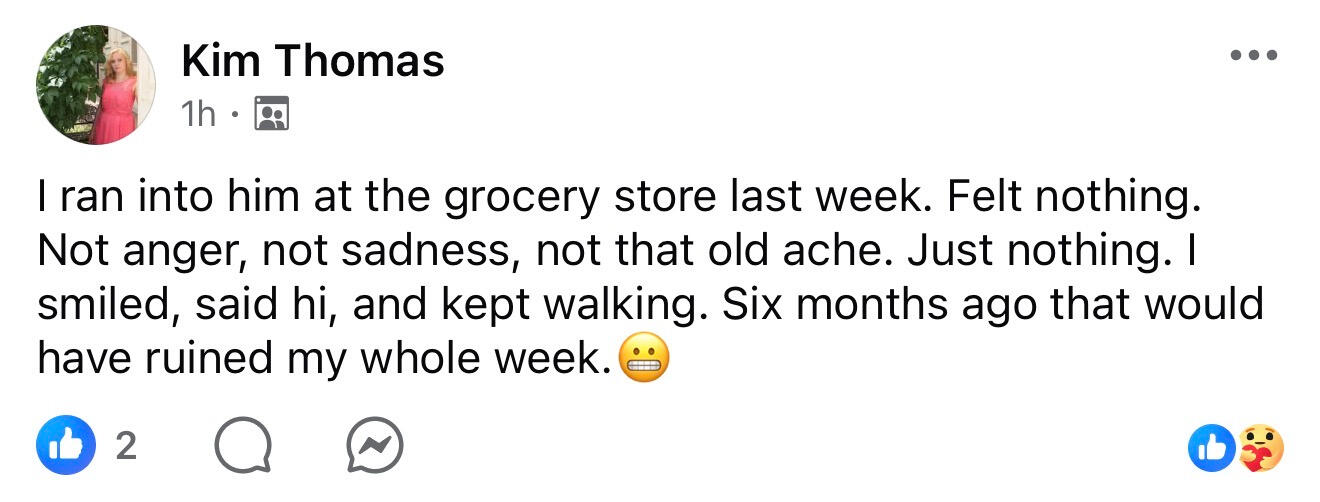
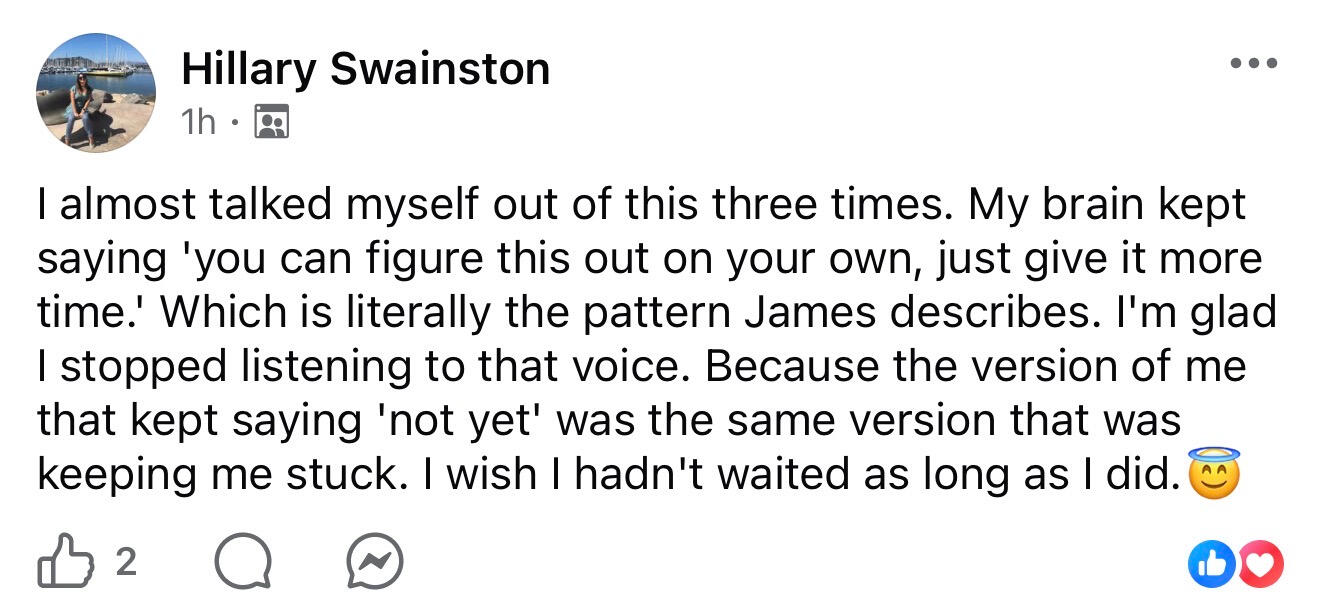
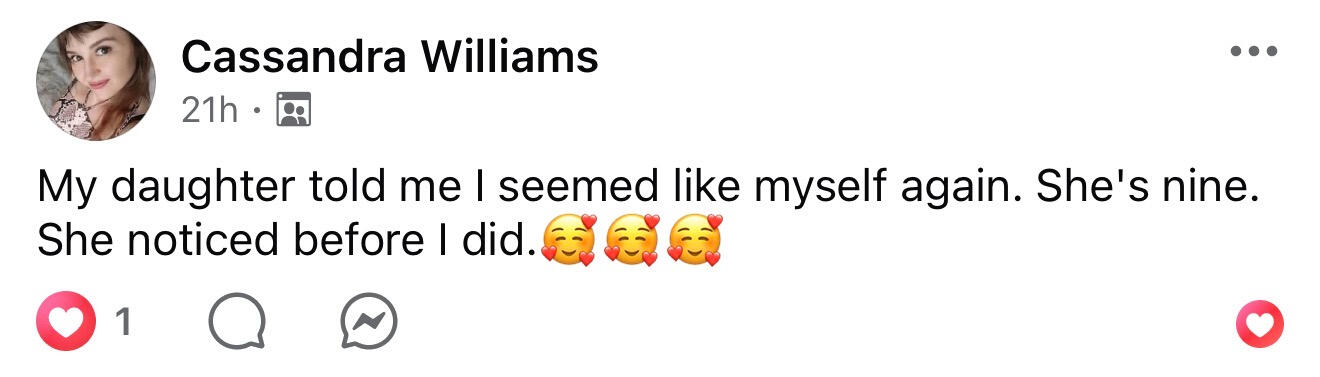
Then the story stopped feeling true. And everything shifted.
"He had no plans to keep me identified with the problem and reliving the pain. He's found a better way."
"This problem that once felt insurmountable was now just a distant memory."
"I finally achieved control over my life and a renewed sense of identity."
"My favorite part was learning how to stop resisting the pain I had spent so many years trying to get over. Now I have the skill to let go and move on."
"I feel amazing, actually. Totally present."
I'm James Stafford
I'm a certified relationship coach who specializes in helping high-achieving, driven women break free from the emotional addiction that keeps them stuck after a divorce.
I've worked with executives, business owners, attorneys, and women who lead teams and manage pressure that would break most people — women who've already done the therapy, done the journaling, done the inner work, given it time… and still can't stop.
The Rewiring Method was developed from the work I did with my neuropsychologist after spending almost three years stuck in the same cycle my clients come to me with.

At This Point, You Have Two Options

You can keep doing what you’ve been doing.
Keep going to therapy.
Keep talking to friends.
Keep replaying it in the car and the shower.
Keep processing.
Keep giving it time.
But you’ve already seen where that leads.
Every one of those things takes you back into the story.
And the story is what produces the emotions your brain is addicted to.
The more you try to heal that way, the more you feed the addiction.
Or You Can Let Someone Show You Where to Interrupt It.
When I finally realized that everything I was doing to heal was the very thing keeping me stuck, I knew I had to find a different way.
And I knew I couldn’t be the only one.
There had to be other people out there doing the same thing.
Trying everything.
Giving it more time.
Going back into the story again and again.
Feeding a version of themselves they were trying to get beyond.
That’s why I created The Rewiring Method.
Not because people need more processing.
But because there had to be a simpler way to see the loop, interrupt the story, and stop feeding the addiction before it takes more time, more peace, and more of who they were becoming.
And that’s what this call is for.
So Now You Have A Choice
Keep fueling the addiction.
Or let someone show you where to interrupt it.
Because once you stop feeding the loop, the story stops feeling as relevant.
The emotions start losing their fuel.
And he stops being someone you carry — and starts becoming someone you used to know.
If You're Ready
If you’ve been stuck in this for months or years…
If you’ve tried therapy, journaling, talking it through, and giving it time…
If you’re functioning on the outside but privately becoming someone you don’t recognize…
The next step is a private Becoming Her 2.0 Vision Call.
This is not therapy.
This is not an hour of talking about your ex.
And this is not a sales call.
It's A Focused Conversation Where I Help You See The Blind Spot That's Been Keeping The Addiction Alive — So You Can Finally Start Seeing Your Situation Differently.
• You'll see what's been pulling you back, why nothing has worked, and what actually needs to change.
• Because the moment you can see the Blind Spot clearly, you stop identifying with it. And that's when real change starts.
• You start to feel more like yourself. More hopeful. Less stuck reliving the same thing over and over again.
• That's why most women walk away from this call feeling lighter than they have in months.
This Is Not For Everyone
If this just happened and you're still in the initial shock — this isn't the right time.
If you're not in a position to invest in yourself — this isn't the right moment.
If you're looking for someone to tell you he's coming back — I'm not that person.
This is for women who've been stuck for months.
Women who've done the work.
Women who can feel themselves becoming more guarded, more reactive, less present, and less like themselves.
Women who are ready to break the addiction.
There's Nothing To Buy On The Call
It's simply a chance for me to show you what's been running underneath.
If I can help, I'll show you the next step.
If I can't, I'll tell you that and point you in the right direction.
Either way, you'll walk away seeing the Blind Spot that's been keeping the addiction alive — which is something most women never get to see from inside it.
APPLY FOR YOUR BECOMING HER 2.0 VISION CALL →
The Addiction Is Doing What It Always Does
You've read this entire page.
You've seen how it works.
You've seen how everything you've tried has been feeding it.
And right now, part of you is pulling back.
"This won't work for me."
"My situation is different."
"I need to think about it."
That's not you being careful.
That's withdrawal.
Your brain just spent this entire page watching someone explain how to take away the emotions it depends on.
And now it's doing what any addiction does when it's threatened — manufacturing reasons to stay.
It will sound like logic.
It will feel like wisdom.
It will disguise itself as being practical.
But it's the same addiction that told you to check his page one more time.
The same addiction that kept you replaying the conversation.
The same addiction that can make your situation feel so complicated that changing seems impossible.
You didn't read this far because you were comfortable.
You read this far because something on this page finally explained what's been happening to you.
That's the part of you to trust right now.
Are you going to let the addiction make this decision too?
APPLY FOR YOUR BECOMING HER 2.0 VISION CALL →
Because every day the addiction keeps running, it wires deeper.
And it doesn't need any more practice.